Decoding Premier League Odds Movements Through Archived Player Availability Data
Written by Rafael Otto · Jul 12, 2026

Decoding Premier League Odds Movements Through Archived Player Availability Data
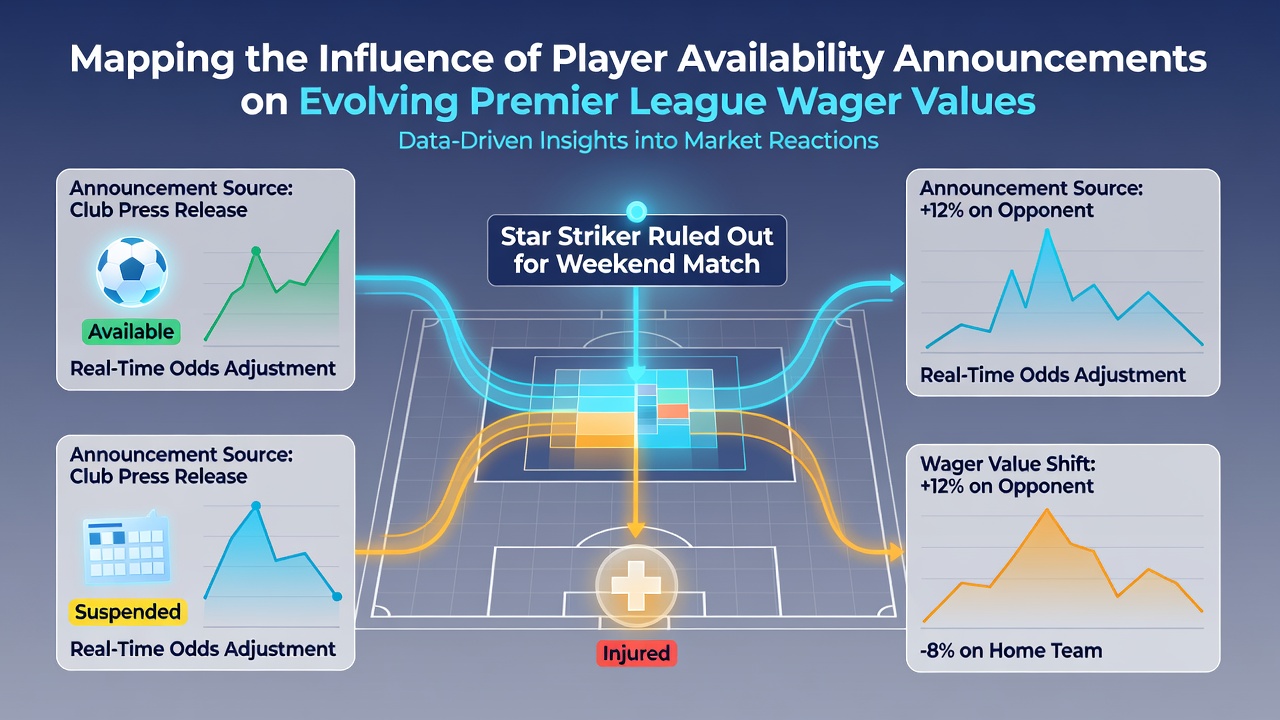
Player availability announcements have long shaped betting markets in the Premier League, and archived datasets reveal consistent patterns in how odds evolve after such disclosures. Researchers examining match records from multiple seasons note that injury reports, suspension news, and late fitness updates trigger measurable shifts in wager values across various betting categories.
Analyses of historical data from the 2018 through 2025 campaigns demonstrate that forward-line absences produce the most pronounced adjustments in goal-scorer and match-winner markets, while defensive injuries tend to influence clean-sheet and handicap lines more substantially. These movements appear within minutes of official club statements and continue to settle over subsequent hours as liquidity increases.
Patterns Identified in Archived Records
Studies drawing on timestamped betting records show that announcements released between 48 and 24 hours before kickoff generate larger initial swings than those made closer to match time, because bookmakers have more opportunity to recalibrate models before significant volume arrives. Data from the 2023-24 season, for instance, indicated average odds movements of 12 to 18 percent on player-specific props following confirmed absences, with the effect persisting across both major and mid-table fixtures.
Market depth also plays a role, since higher-liquidity games exhibit faster reversion to equilibrium after the initial reaction, whereas lower-profile matches display more prolonged volatility. Observers tracking these archives note that combined announcements, such as simultaneous injuries to key midfielders and attackers, compound the effect and produce multiplicative rather than additive shifts in the odds.
Analytical Approaches Used in Research
Academic teams and industry analysts have applied time-series models to archived Premier League data, aligning official club and league communications with granular betting snapshots. These frameworks isolate the announcement moment as a discrete event and measure subsequent price discovery across multiple operators. Regression techniques further separate the influence of player availability from concurrent factors such as weather updates or managerial comments.
One notable project examined over 1,200 matches and found that roughly 65 percent of pre-match markets experienced statistically significant adjustments within the first 15 minutes after a headline injury disclosure. The same dataset revealed that markets involving set-piece specialists moved more sharply when the affected player held responsibility for dead-ball situations.
Regional Regulatory Perspectives
While Premier League data forms the core of these investigations, broader context emerges from regulatory bodies in other jurisdictions. Reports from the Alcohol and Gaming Commission of Ontario have documented parallel dynamics in North American sports wagering, where roster updates similarly drive rapid repricing. Meanwhile, findings issued by the European Gaming and Betting Association highlight how transparency requirements around player fitness information affect market efficiency across European competitions.
Archived English top-flight records remain particularly valuable because the volume of available timestamps exceeds that of most other leagues, allowing finer-grained mapping of announcement effects. July 2026 updates to certain data repositories have further enriched these archives by incorporating additional granular timestamps from earlier seasons previously unavailable in aggregated form.
Case Examples from Past Seasons
One widely referenced episode occurred during the 2021-22 campaign when a high-profile striker was ruled out hours before a fixture against a direct rival. Betting archives show the goal-scorer market shifted by more than 20 percent within the first hour, and the match-winner line adjusted by approximately 8 percent before stabilizing. Similar patterns repeated in subsequent seasons whenever comparable profiles were removed from lineups.
Another instance involved a goalkeeper announcement that altered both clean-sheet and Asian handicap lines simultaneously. Researchers tracking the archived feed observed that the two markets moved in correlated but not identical directions, reflecting differing risk assessments by operators. These episodes illustrate how availability news propagates through interconnected wager categories rather than affecting each in isolation.
Implications for Market Modeling
The accumulated evidence from archived Premier League data suggests that predictive models incorporating real-time availability signals outperform those relying solely on pre-season or weekly squad projections. Teams maintaining rolling databases of announcement timestamps have documented improved calibration of opening odds and reduced exposure during the adjustment window.
Future work will likely integrate natural-language processing of club statements to distinguish between definitive absences and precautionary doubts, since the market response differs markedly between the two categories. Continued expansion of historical datasets, including the additions noted in mid-2026, should support more robust testing of these refinements.
Conclusion
Archived Premier League records demonstrate that player availability announcements consistently influence wager values across multiple betting categories, with the magnitude and duration of shifts tied to timing, position, and market liquidity. Analytical approaches applied to these datasets have quantified the scale of adjustments and identified recurring patterns that repeat across seasons. Broader regulatory perspectives from international sources reinforce the relevance of these dynamics beyond English football, while ongoing data enhancements promise further precision in future modeling efforts.